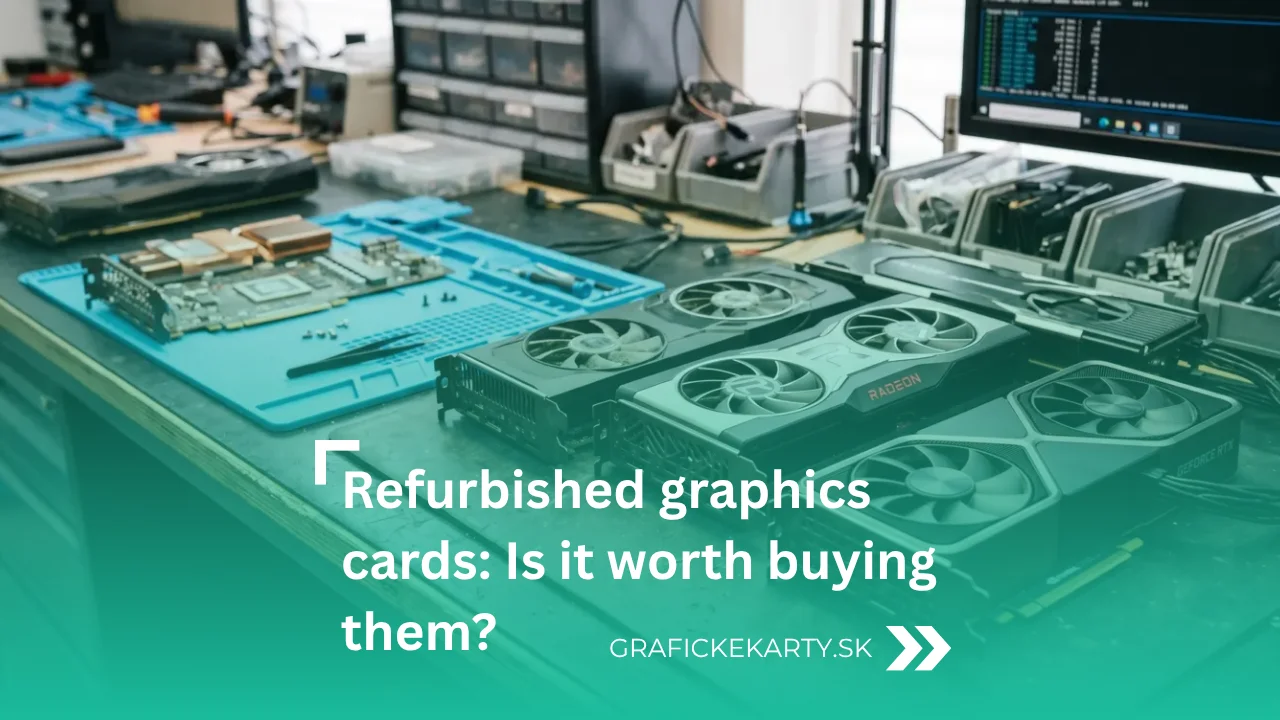
Refurbished graphics cards are becoming increasingly common on the U.S. market. Websites like eBay, Newegg, and Amazon Renewed feature dozens of listings every month – sometimes even high-end cards at prices significantly lower than new ones. It’s tempting, but the doubts are understandable: you don’t know what the previous owner did to the card, whether its performance has deteriorated, or if it will quietly die on you in a month.
The answer isn’t clear-cut either way. Some people have used refurbished cards for years without any issues. Others have encountered units that broke down after two months and couldn’t be returned. In most cases, the difference lies in where and under what conditions they bought the card —not in the card’s condition itself. This article will help you figure out what to look for, what to avoid, and when a refurbished graphics card actually makes sense.
Most importantly:
- Refurbished graphics cards can be an excellent choice – but the key is the seller and the warranty, not the card itself.
- The performance of a refurbished GPU is practically unchanged compared to a new one – graphics chips don’t degrade over time; they simply either work or they don’t.
- Unlike in Europe, where you are legally entitled to a 24-month warranty on goods purchased from a registered retailer, the U.S. market operates differently. There is no federal law mandating a specific warranty period for refurbished electronics. In most cases, the length of the warranty depends entirely on the seller or the manufacturer, ranging from a 30-day return window to a limited 90-day or 1-year coverage.
- A card that was used for cryptocurrency mining isn’t necessarily worse —it depends on how it was operated, not what it was used for.
- Second-hand sales between private individuals are the riskiest—no legal protection, no verified card history.
What exactly does a refurbished graphics card mean?
The term “refurbished graphics card” can mean very different things – and that’s the first problem you’ll encounter. This label covers products in various conditions:
- Returned by a customer – the card was purchased, opened, and returned within the warranty period. The reason for the return could be anything from “I didn’t want it” to “something wasn’t working.” It may be in perfect condition.
- Card repaired after a defect – it was sent to a service center, a specific fault was fixed (for example, a fan or capacitor was replaced), and it was returned to sale.
- Card replaced by the manufacturer – the customer filed a complaint, the manufacturer sent a new one, and put the old one into a refurbishment program.
- Used card in flawless condition – the graphics card was used for normal purposes and the owner subsequently decided to sell it. The company that bought it from him then inspected it, cleaned it, performed basic maintenance if necessary, and offered it for sale.
- Excess inventory – the card has never actually been used, but cannot be sold as new. Sometimes it even comes in its original, sealed packaging.
The key question, therefore, is not “is this a refurbished card?” but “what exactly has been done to it, and who stands behind it?” A refurbished card from a verified seller with a warranty and documentation is something entirely different from a “refurbished” card from a flea market sold by an anonymous seller.
Does a refurbished graphics card lose performance?
Many people assume that refurbished graphics cards must perform worse than new ones. This is one of the most common concerns and, at the same time, a topic surrounded by many myths. The short answer: graphics chips do not gradually lose performance.
GPU cores degrade through a process called electromigration—the gradual wear and tear of conductors caused by the flow of electric current. However, this process is extremely slow and takes decades under normal use. In practical terms: the card simply does not degrade in performance gradually. It either continues to perform at its original level, or it begins to show instability and fails completely. There is no middle ground in the form of “a card that performs 15% worse than a new one.”
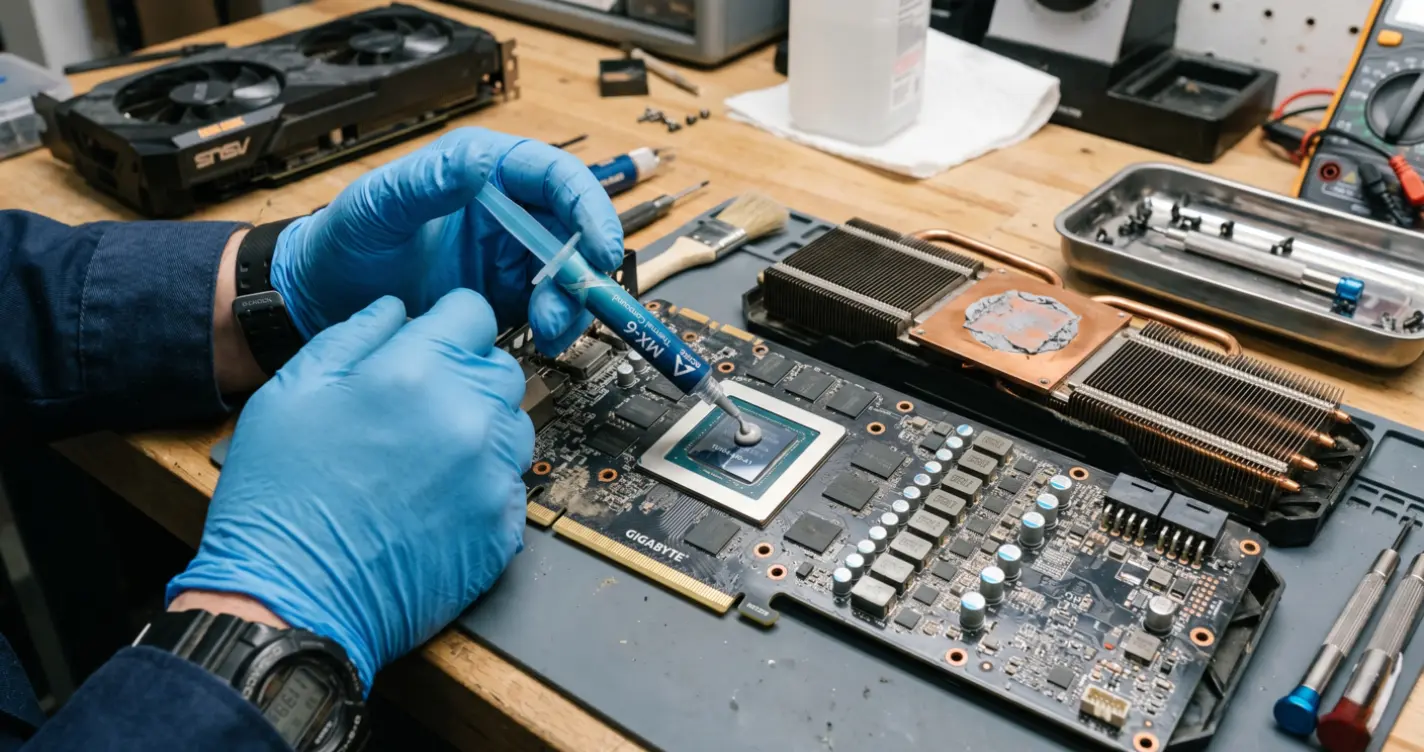
What can deteriorate and directly affect performance, however, are the thermal paste and cooling. Dried-out or originally insufficiently applied paste causes overheating, which leads to thermal throttling – the card automatically reduces its frequency to protect itself. The result looks like a loss of performance, but the cause isn’t chip degradation – it’s poor cooling.
That’s why one of the most important steps when buying a refurbished card is to replace the thermal paste immediately after purchase. It’s a matter of a few euros that can make a significant difference in temperatures and stability. Some companies offer this service even before selling the refurbished card, so you receive a graphics card with flawless cooling, just as if it were brand-new from the manufacturer.
A card used for cryptocurrency mining: myth or real risk?
“All refurbished cards have been used for mining” – this argument comes up regularly in discussions and is partly true, partly misleading. During the peak of the crypto boom from 2020 to 2022, a truly large number of GPUs ended up in mining farms. Hundreds of thousands of used cards later entered the market.
The problem isn’t mining itself. During mining, GPUs run at a stable, relatively low load and at consistently moderate temperatures —which, in terms of hardware wear and tear, is far less stressful than intensive gaming with fluctuating loads and sudden temperature changes. Long-term stability tests repeated across various technical communities have consistently confirmed that GPUs show no measurable loss of performance compared to new cards after two years of continuous mining.
The real risks with cards from mining farms are related to other factors: fans running continuously for months, dried-out thermal paste, neglected maintenance, and sometimes even improper voltage settings aimed at maximizing hashrate. So it’s not the chip itself, but the cooling condition and the history of settings that need to be checked.
Where to buy refurbished graphics cards
There are several distinctly different categories of sellers on the U.S. market. Each offers a different balance of price, risk, and buyer protection.
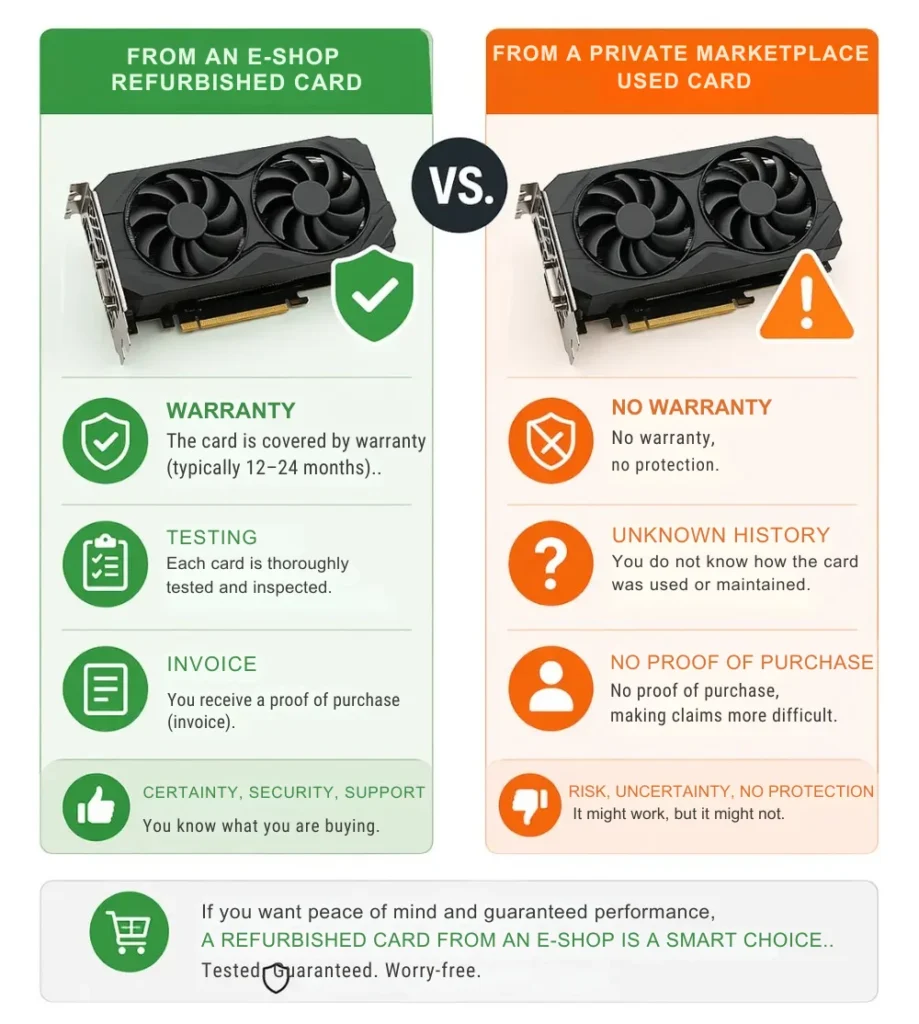
Verified e-shops selling refurbished goods
Major retailers such as Newegg (Refurbished) and Amazon Renewed offer a wide selection of graphics cards that have undergone inspection, cleaning, and professional testing. These platforms typically provide a 90-day to 1-year limited warranty on refurbished products, along with standard return windows (usually 30 days). Specialized stores like Micro Center also offer “Open Box” deals that are professionally verified by their in-store technicians. For professional-grade GPUs (such as the NVIDIA Quadro or RTX A-series), retailers like Dell Outlet or dedicated workstation suppliers provide the most reliable experience, often including documented stress-test reports and extended manufacturer support.
Advantages: warranty period, right to file a complaint, verifiable seller history, return policy.
Disadvantages: the price is higher than for second-hand offers, and selection may be limited.
Grafickekarty.sk – refurbished GPUs with the highest level of reliability
If you’re looking for a refurbished graphics card and don’t want to take any risks, grafickekarty.sk sets a standard that other options on the market simply can’t match.
Every card undergoes a detailed stress test at full power. You’ll receive the test results – including a comparison with the performance of a new model of the same GPU – as part of your order, so you know exactly what you’re buying before the card even arrives. In addition, detailed photos of the card are included, showing its actual condition before shipment. Not marketing shots, but real photos of the specific unit you’ll receive.
A complete cleaning of the card is also standard, along with the option for additional service procedures:
- replacement of thermal paste,
- thermal pads,
- fanreplacement.
We offer a standard 24-month warranty on every refurbished card , with the option to extend it up to 4 years – which is significantly longer than anywhere else on the market. Our prices are set to be competitive with other trusted retailers.
If, after receiving the detailed test report and photos, you are unsatisfied with the condition or performance of the card for any reason, you can cancel your order – no questions asked. This is a level of transparency you won’t find elsewhere when it comes to refurbished hardware.
We are currently preparing a selection of refurbished graphics cards, which we will publish soon.
Peer-to-Peer Marketplaces: eBay and Facebook Marketplace
Lowest price, highest risk. On platforms like eBay or Facebook Marketplace, you will find dozens of listings for used and refurbished cards – from both private sellers and small-scale resellers. The selection is vast, and prices are significantly lower than retail.
However, when buying from a private individual, you as the buyer have much less protection. In the U.S., private sales are typically considered “as-is” transactions. Consumer protection laws do not apply to these deals, and there is no statutory warranty. If the card fails a month after you bought it, you have little to no recourse, and getting a refund is rarely an option.
When it makes sense: Buying from a private seller is a viable option only if they can provide the original purchase invoice, any remaining manufacturer’s warranty, and – ideally – if they agree to a local, in-person pickup where you can test the card under load before finalizing the payment.
Verified Marketplaces: Amazon Renewed and Back Market
If you want professional quality without the risks of private sellers, platforms like Amazon Renewed and Back Marketare your best options. Both act as intermediaries that connect you with vetted, professional refurbishers.
- Amazon Renewed: One of the most trusted paths for refurbished hardware in the U.S. Sellers must meet strict quality standards for inspection, testing, and cleaning. Amazon backs these purchases with a 90-day to 1-year limited warranty and their standard, hassle-free 90-day return window.
- Back Market: A specialized marketplace for refurbished goods. They also mandate a minimum 1-year warranty from their professional sellers, providing a strong sense of security. Because they focus exclusively on refurbished gear, their vetting process is often very granular, though shipping times may vary depending on the specific third-party seller.
The main benefit: Unlike private deals, you are protected by the platform’s customer service. If the card is faulty or doesn’t meet the description, you have a clear path to a refund.
Comparison of options for purchasing a refurbished graphics card
| Purchase option | Warranty | Performance test | Photo documentation | Risk |
|---|---|---|---|---|
| Grafickekarty.sk | 24 months (extendable up to 4 years) | Yes – stress test | Yes – detailed photos before shipping | Minimum |
| Amazon Renewed | 90 days – 1 year | Standardized inspection | Varies | Low |
| Back Market | Min. 12 months | Verified seller check | Standardized | Low |
| eBay (Private Seller) | None (as-is) | None | Depends on the seller | Medium to High |
| FB Marketplace | None (as-is) | None | None | High |
What the Law Says: Your Rights When Buying a Refurbished Graphics Card
Your legal protection as a buyer depends entirely on the status of the seller. In the U.S., there is no federal mandate that guarantees a warranty on used or refurbished goods. Your rights are primarily governed by the terms of the sale and the Uniform Commercial Code (UCC).
If you are buying from a private individual (eBay, Facebook Marketplace, Craigslist): Consumer protection laws generally do not apply to private, peer-to-peer transactions. These are legally considered “as-is” sales. Unless the seller has committed fraud or misrepresented the item’s condition in writing, you have virtually no legal recourse if the card fails shortly after purchase. The burden of due diligence lies entirely with you, the buyer.
If you buy from a registered merchant (e-shop, specialized retailer, Amazon Renewed): Your rights are defined by the seller’s specific store policy. While some states have “implied warranty of merchantability,” most retailers sell refurbished items “as-is” or with a limited store warranty (typically 90 days to 1 year). Always check the seller’s specific Return Policy and Warranty Terms before purchasing. Legally, the store is only bound by what they explicitly promise in their terms of service, not by a universal statutory warranty.
Important: Warranty vs. Return Policy In the U.S., a Return Policy is your immediate protection, while a Warrantyis a long-term safety net. Unlike European consumer law, there is no federal mandate that presumes a defect existed at the time of sale. You are only protected by what the seller explicitly guarantees in their Terms of Sale. Always check the return window before you buy, as your options for recourse disappear once that period expires.
Pro-tip: Consider Extended Protection Since there is no federal law governing defect liability, consider purchasing an extended protection plan (often offered at checkout on sites like Amazon or through third-party providers like Allstate). For a small fee, these plans extend your coverage beyond the standard 90-day or 1-year warranty. If your refurbished card fails after the seller’s initial warranty period, this is often the only way to get a repair or a replacement without paying out of pocket.
How to test a refurbished graphics card after purchase
This is one of the most important steps that many people skip – and then regret. If you buy a refurbished graphics card and store it in a drawer for a month without testing it, you may lose the opportunity to file a claim more easily. The sooner you check its functionality, the better.
Basic tests that anyone can do
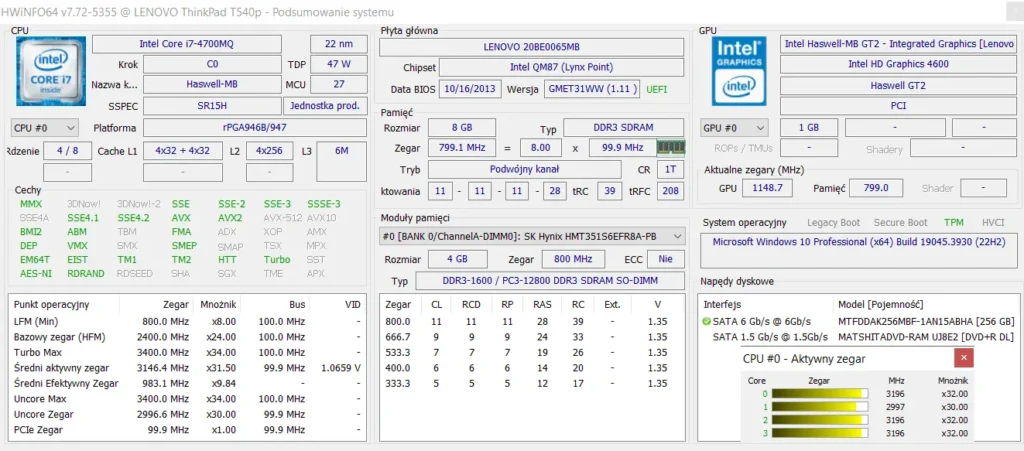
- MSI Afterburner HWiNFO64. These free tools will show you real-time GPU temperatures, core and memory frequencies, and fan speeds. Run a game or a YouTube video and see if the card heats up to reasonable levels (up to 85 °C is standard for most cards).
- FurMark or 3DMark. Stress tests that keep the card running at full power for several minutes. If the card fails without crashing, displaying artifacts, or reaching extreme temperatures, that’s a red flag.
- Visual inspection. Check the fan (it should spin smoothly without squeaking), the PCIe connector, the heatsink (no corrosion or rust spots), and the PCB itself (no burn marks or mechanical damage).
- Verify the manufacturer’s warranty using the serial number. Some manufacturers allow you to check the warranty status online by entering the serial number. Find out how much warranty time is left on the card—it could be good news or a timely warning.
What to look out for when picking up in person
When buying from a private seller, always insist on in-person pickup, where you can test the card directly at the seller’s location. Ask to run a stress test on the spot. A card that “works fine” according to the seller but overheats to 100 °C during the first stress test is not in good condition.
Refurbished graphics card: when it’s worth it and when it isn’t
The decision to buy refurbished graphics cards depends on each buyer’s specific situation. Here’s an overview of scenarios where it makes sense—and where it doesn’t.
When a refurbished card makes sense
- A significant price difference compared to a new card. If a refurbished card is significantly cheaper (usually 20% or more) and comes from a trusted seller with a warranty, the price difference can offset the higher risk.
- A card from a verified seller with a warranty. A refurbished card with a 24/12-month warranty is close to a new card in terms of risk – you have legal rights and a verified background.
- Older-generation cards for light use. For office PCs, videos, or older games at lower resolutions, a mid-range refurbished card can provide sufficient performance at a fraction of the price of a new one.
- Professional GPUs (Quadro series). New professional graphics cards are extremely expensive. Refurbished NVIDIA Quadro cards from specialized retailers like Technimax are a common and sensible choice for small and medium-sized businesses.
When a refurbished card isn’t worth it
- No warranty or with a “do not open the package “condition. The “no returns once opened” policy is absolutely unacceptable for PC components. There is no way to verify functionality without installing the card. Such conditions are a clear red flag.
- From an unknown seller with no reviews. If you can’t find any references, reviews, or verifiable contact information for the seller, the risk is too high regardless of the price.
- When the price difference is minimal. If a refurbished card costs only 10–15% less than a new one with a full manufacturer’s warranty, the warranty and reliability of a new card are likely a wiser investment.
- For demanding professional use. If your work depends on the card and a failure would have financial consequences, the risk of a refurbished card without a full warranty is hard to justify.
What the community’s experience says
People’s experiences with refurbished graphics cards are sharply divided —and not by accident. Those who bought from verified sellers with a warranty mostly report positive results. Those who went for a cheap deal without a warranty or rigorous vetting ended up getting burned.
One recurring story in discussions: buying a used card without a warranty, the card works for a few weeks, then stops – and a return isn’t possible. Thousands lost, the need to buy another card, total cost higher than if a new one had been bought from the start. This is not an exception – it is a fairly common scenario when buying without a warranty.
On the other hand, there are people who have been using refurbished cards for years without any problems – including cards purchased four or five years ago that are still running smoothly today. The common thread in these positive stories is usually that they bought the card from a trusted source, tested it immediately after purchase, replaced the thermal paste, and had the peace of mind that comes with a warranty.
Refurbished graphics cards are therefore not inherently bad – they are only as good as the seller behind them.
Frequently Asked Questions
Not necessarily. A used card is simply a card that someone previously owned. A refurbished card has undergone some sort of inspection, repair, or restoration process. In practice, it depends on the seller: refurbished from a verified e-shop means a documented inspection and warranty. “Refurbished” from a private seller without documentation may simply mean that the seller blew dust out of the cooler.
If you purchased from a registered retailer, your rights are defined by the store’s specific Return Policy and Warranty Terms. If the card is faulty, you are entitled to a resolution—such as a repair, replacement, or refund—provided the defect is covered under your purchase agreement. Always keep your invoice as it serves as your only binding contract.
If you bought from a private individual, filing a complaint is significantly more difficult as these are typically “as-is” transactions. Consumer protection laws generally do not apply to private sales, and unless the seller intentionally misrepresented the item, you have little to no legal recourse. Your best defense is to thoroughly test the card before finalizing the payment.
No, the graphics chip’s performance itself does not change due to mining. GPU cores do not degrade gradually in terms of performance—they either function fully or fail. What can deteriorate is the cooling system (clogged fans, dried-out thermal paste) and mechanical parts. After replacing the thermal paste and cleaning the heatsink, such a card often works just as well as a new one.
There’s no completely reliable way to tell. You can check the condition of the fans (they tend to be more worn out from intensive mining), temperatures during a stress test, and any BIOS settings. If the seller can’t provide a purchase invoice or the card’s history, you’ll have to decide based on the overall condition and price.
There is no hard and fast rule, but as a rough guideline: 20 to 35% below the price of a new model is a reasonable difference at which it is worth considering a refurbished card from a verified seller. A difference of less than 15% hardly justifies giving up the manufacturer’s warranty. More than 40% below the new price from an unknown seller should be a red flag—not a good deal.
You can handle basic testing yourself using free tools: MSI Afterburner to monitor temperatures and frequencies, HWiNFO64 for detailed hardware statistics, and FurMark or 3DMark as a stress test. If you’re unsure, most service centers in Slovakia can professionally test the card for a small fee.