


The dawn of 2026 confirms that personal computer infrastructure is undergoing a transformation unlike anything we have seen in two decades. For most users today, the main question is the difference between PCIe 4.0 and 5.0, especially in relation to the new NVIDIA Blackwell and AMD RDNA 4 graphics cards. However, the battle for bandwidth has long since moved on, and while the mainstream market is adapting to PCIe 5.0, the professional sphere is already dominated by the revolutionary PCIe 6.0. This analysis explores the evolutionary path from binary signaling to PAM4 modulation and explains why these changes are necessary.
Physical Limits and the Era of Binary Signaling – PCIe 4.0 vs 5.0
When looking for the answer to the question of what PCIe 4.0 vs 5.0 brings, we must start with the basics of data transmission. The PCIe 4.0 and 5.0 standards represent the pinnacle of the traditional approach to information transfer using NRZ (Non-Return-to-Zero) encoding, also known as PAM2 in engineering circles. This system works on the principle of two voltage levels representing logical zero and one. Although this concept is simple and has been reliable for decades, at the extremely high frequencies of modern hardware, it comes up against the relentless physics of copper conductors.
PCIe 4.0: Today’s stable mainstream
In terms of commercial use in 2026, PCIe 4.0 remains a stable pillar of most systems. It operates at a Nyquist frequency of 8 GHz, allowing it to reach speeds of 16 GT/s per lane. For most gaming titles and common work tasks, this standard is still considered sufficient.
The key challenge in its design was to maintain signal integrity while adhering to strict differential pairing and wave impedance control at 85-100 ohms. When designing PCBs, engineers must ensure that any deviations in path length do not exceed critical limits, as phase shift at 8 GHz can completely degrade the data packet and cause system instability.
PCIe 5.0: Will you really use its full potential?
With the arrival of PCIe 5.0, the challenges have multiplied dramatically as the frequency has doubled to 16 GHz (32 GT/s). However, this increase has brought an exponential increase in signal attenuation, known as insertion loss. At a frequency of 16 GHz, a phenomenon called the skin effect occurs, where electromagnetic waves propagate primarily along the surface of the conductor, dramatically increasing resistance and degrading the signal after just a few centimeters.
Common materials for manufacturing base boards, such as the affordable FR4 composite, will become unusable for high-end components in 2026 due to their high dielectric loss factor. Manufacturers are forced to switch to more expensive low-loss laminates such as Megtron 6 or Tachyon 100G, which naturally increases the final price of products.
To ensure transmission over longer distances (for example, from the CPU to a more distant graphics card slot), retimers have become mandatory equipment. These are active chips that not only amplify the signal but also completely reconstruct it, eliminating jitter (time instability) and “cleaning” the signal before it reaches its destination. In addition, PCIe 5.0 controllers are designed with a high degree of intelligence—they can instantly switch to legacy PAM2 modes when older hardware is detected, ensuring perfect backward compatibility.


The PCIe 6.0 revolution: Transition to PAM4 and FLIT logic
A real technological breakthrough will come in early 2026 with the deployment of PCIe 6.0 in the enterprise sphere and workstation platforms. While in the comparison of PCIe 4.0 vs 5.0 we only talked about increasing the frequency, this standard definitively abandons the NRZ scheme in favor of PAM4 (Pulse Amplitude Modulation with 4 levels).
PAM4 is revolutionary in that it can transfer two bits per clock cycle (symbol). Instead of two voltage levels (0 and 1), it uses four voltage states corresponding to the binary combinations 00, 01, 10, and 11. This allows for a throughput of up to 64 GT/s (approximately 256 GB/s of raw transfer speed for an x16 slot) while maintaining the same 16 GHz Nyquist frequency used by PCIe 5.0.
Thanks to this approach, engineers have avoided even more drastic signal attenuation, which would inevitably result from a higher frequency. However, this shift comes at a price. Because the four voltage levels in PAM4 are “crammed” together in the same range, the signal eye (the horizontal and vertical space where the signal is readable) is significantly smaller. This makes the signal extremely susceptible to noise and crosstalk.
To ensure that the bus is stable and usable in real hardware in 2026, PCIe 6.0 introduces two key innovations that change the way data travels over the bus:
- FEC (Forward Error Correction): This is an advanced algorithm that allows the receiver to identify and correct bit errors in real time without the need for retransmission (requests to resend data). Combined with Gray coding (where neighboring voltage states differ by only one bit), this ensures extremely low error rates while maintaining minimal latency, which is below 2 ns.
- FLIT mode (Flow Control Unit): This is a fundamental change in logic. Unlike older generations, which sent packets of variable length, PCIe 6.0 organizes data into fixed 256-byte blocks (FLITs). This approach dramatically simplifies the work of decoders and allows for maximum FEC efficiency. In addition, it completely eliminates the older and less efficient 128b/130b encoding overhead, increasing the net bus throughput.
Why is the user community questioning the PCIe 5.0 upgrade?
When analyzing the market in 2026, we cannot ignore the voice of end users. A detailed look at discussions on platforms such as Quora and Reddit, as well as on social networks, indicates a strong distrust of the real benefits of PCIe 5.0 in the consumer segment. The majority opinion of the community has settled on the fact that, although technological progress is fascinating, a direct comparison of PCIe 4.0 vs 5.0 shows that for the average gamer, the benefits of the fifth generation are rather theoretical. Many enthusiasts openly argue that the industry has reached a point where the price and cooling requirements are growing much faster than the real comfort of using a PC.
This wave of pragmatism in 2026 is best defined by the following key points:
- SSD: Speed on paper vs reality (4K QD1): PCIe 5.0 drives may boast an impressive 14 GB/s, but this only applies to sequential reading of huge files. Normal system operation and game loading depend on random reading of small files. In this discipline, the differences between Gen 4 and Gen 5 are almost negligible.
- GPU: PCIe 5.0 as a marketing shield: Although the latest graphics cards of 2026 natively support PCIe 5.0, community tests repeatedly show that the performance drop when connected to a PCIe 4.0 slot is negligible in 4K resolution (often less than 2-3%). For gamers, this is a clear signal that an expensive motherboard upgrade will not actually bring them any extra FPS.
- Overheating and noise issues: Extreme performance has brought extreme heat. Most PCIe 5.0 components today require massive heatsinks or noisy cooling. This is an unacceptable price for the community to pay—no one wants another small “vacuum cleaner” in their quiet PC just to load a game a second faster or gain a few points in a benchmark.
- Real system bottlenecks: Users realize that their PCs are bottlenecked elsewhere. Whether it’s internet speed when downloading or the processor’s ability to unpack data at lightning speed. The PCIe 5.0 bus itself remains a “luxury” in the eyes of the public for 8K video editors and artificial intelligence experts, not a necessity for everyone.
We also bring you a table comparing PCIe 4.0 vs 5.0 vs 6.0 for a better understanding of the limits of each version.
| Technical parameters | PCIe 4.0 | PCIe 5.0 | PCIe 6.0 |
| Signaling method | NRZ (PAM2) | NRZ (PAM2) | PAM4 |
| Bits per symbol | 1 bit | 1 bit | 2 bits |
| Nyquist frequency | 8 GHz | 16 GHz | 16 GHz |
| Line coding | 128b/130b | 128b/130b | 256b/242b (FLIT) |
| Error correction | CRC only | CRC only | Mandatory FEC |
| Max. throughput (x16) | ~31.5 GB/s | ~63 GB/s | ~121 GB/s (net) |
| Signal loss limit | 28 dB | 36 dB | 32–36 dB |
Synergy with GDDR7 and CXL: A new ecosystem
In 2026, card performance will no longer be determined solely by its core, but by how effectively it can work with the rest of the system. We are talking about the highest levels of current hardware, where PCIe 5.0/6.0 standards, the CXL (Compute Express Link) protocol, and new GDDR7 memory meet.
Although current gaming cards such as the NVIDIA RTX 50 (Blackwell architecture) use PCIe 5.0, their professional counterparts (designed for AI and servers) are already fully transitioning to PCIe 6.0. It is in this professional sphere that the CXL add-on enables lightning-fast sharing of system RAM with graphics. This is a breakthrough for local AI – if the model does not fit into your card’s VRAM, the GPU will “borrow” capacity from the RAM via this ultra-fast bus without dramatically reducing graphics performance.
This technology triangle will define the limits of modern GPUs in 2026 using two different approaches to encoding:
- PCIe 6.0 and PAM4 encoding: To achieve extreme speeds over longer motherboard routes, the sixth generation of PCIe uses PAM4 (4 voltage levels) encoding, which transmits 2 bits per cycle. It is extremely powerful but demanding in terms of stability.
- GDDR7 and PAM3 encoding: In contrast, the new GDDR7 graphics memory uses a “middle ground” approach – PAM3 encoding (3 voltage levels), which transmits 1.5 bits per cycle. Engineers chose this different approach to maintain stability and lower temperatures at extreme graphics memory frequencies than would be produced by the more aggressive PAM4.
Where are these high levels actually used? While GDDR7 memory can be found in every new mid-range and high-end gaming card, the full power of PCIe 6.0 and CXL will be the exclusive domain of AI workstations and server farms in 2026. For the average gamer with an RTX 50 series card, PCIe 5.0 remains the gold standard, while PCIe 6.0 represents the path the gaming segment will take in the coming years.
Verdict: Is it worth worrying about PCIe 4.0 vs 5.0?
The battle between PCIe 4.0 vs 5.0 today is not about seeking higher FPS, but about being ready for the future. While PCIe 6.0 with its PAM4 modulation is revolutionizing data centers, the fourth generation remains relevant for the average user. However, if you are building a new rig in 2026, PCIe 5.0 is a sensible investment, mainly because of the architecture of new GPUs and the potential of DirectStorage, although you will feel the real performance difference between PCIe 4.0 and 5.0 more when working with huge amounts of data than in games themselves.

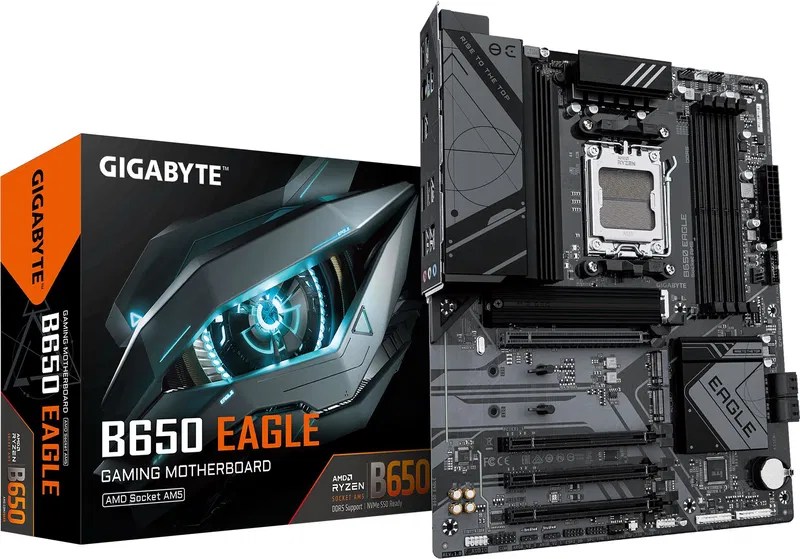
Whether you’re looking for PCIe 4.0 stability or PCIe 5.0 performance for Blackwell GPUs, a quality motherboard is essential. Explore Amazon’s selection of models that ensure maximum data throughput without losses.