
A new Intel graphics card has made its first appearance in international customs databases, where shipments of components marked as 300W GPUs have been recorded. These are the type of records that have often revealed unannounced products in the past, and so have attracted attention this time around. According to the available data, Intel is testing the highest TDP model in its consumer lineup to date, which immediately raises the question of whether the company is heading into a power class that it has so far left to competitors AMD and NVIDIA.
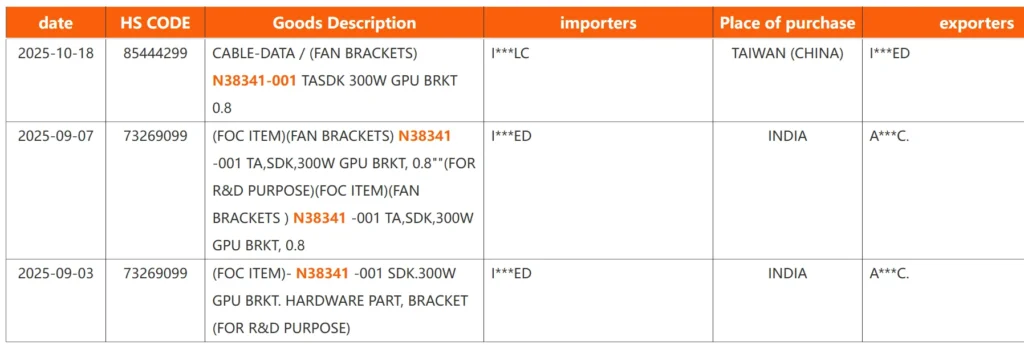
This is an extract from an international customs and logistics database where shipments of goods between the companies are recorded. This type of database tracks the movement of components around the world and can tell what parts were shipped, to whom, from where and in what category.
What the shipment data shows and why 300 W is important
The manifest contains the part identification “N38341-001”, which fits the nomenclature system Intel uses for desktop graphics chips. The most interesting detail, however, is just the 300W TDP. Such a value suggests that the new Intel graphics card may belong to a power class not yet occupied by Intel. Meanwhile, the higher power consumption limit is not just a cosmetic figure – if the information is confirmed, the GPU is likely to deliver:
- a significantly larger number of computing blocks,
- the ambition to compete with the high-end mainstream,
- the potential for more aggressive clocking,
- a redesigned power supply and PCB beyond what Arc models have offered so far.
While the document does not mention a specific architecture, given the timing, it is assumed to be related to the Battlemage generation or its high-performance variant expected in 2026.
ňHigher TDP allows for the deployment of more powerful shader units, wider memory interfaces as well as higher clock speeds for rasterization and ray tracing. Arc chips have so far been limited by both lower frequency and worse performance scaling, especially compared to architectures from AMD and NVIDIA. However, the new Intel graphics card could gain ground:
- a more robust SM/xe-core configuration,
- frequency increases of tens of percent,
- the use of faster VRAM (probably GDDR6),
- significantly more powerful RT blocks.
At least 2.5-slot cooling or a vapor-chamber solution is already expected in this performance category, further confirming that Intel is testing GPUs belonging to a higher performance class.
Market context and what the high TDP may actually indicate
According to the data above, the new Intel graphics card targets a segment where NVIDIA Blackwell models dominate the mid- and high-end today, where graphics cards with power consumption of around 300 W are commonly found. It is a high-efficiency architecture with a powerful memory subsystem. AMD is aiming a bit lower in the RDNA 4 generation, but power consumption in the 250-300 W range is just as common in wider bus and high-performance configurations.
If Intel is indeed preparing GPUs with TDPs at 300 W, it would mark a significant change in strategy. Instead of models with an emphasis on performance/price ratio, the company would enter a segment where raw performance and direct competition with AMD and NVIDIA are the deciding factors. This would be the first attempt for Intel to position itself among the performance-ambitious dedicated GPUs.
Meanwhile, the 300W entry also hints at technical changes. Such a card may use a larger and more powerful chip, a more massive or faster memory interface, a more powerful ray-tracing block, or higher clock speeds that require both a quality power supply and a stable PCB. However, TDP alone says nothing about efficiency. Intel may also bring a revamped cache hierarchy, a better shader scheduler or a more powerful backend, which could significantly improve performance per watt over the Alchemist generation.
Conclusion: realistic leak, but key details are still missing
Although this is an anecdotal leak, the form of the documents suggests that the component exists at least in the testing phase. Thus, the new Intel graphics card seems to represent a realistic project that may for the first time push Intel into the performance class where AMD and NVIDIA dominate today. Until further details or an official announcement emerges, the leak remains a relevant but still untested hint of Intel’s desktop GPU ambitions.
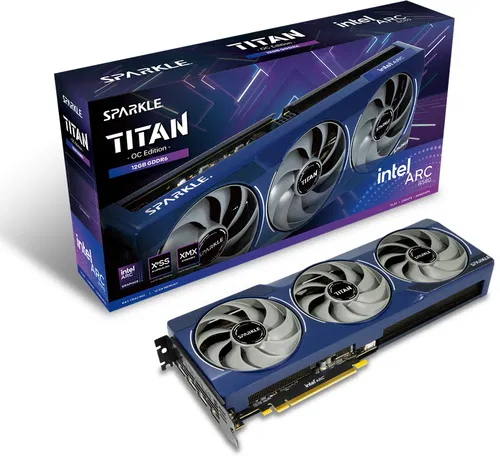
Check the current Intel Arc graphics card lineup and pick the model with the best price-to-performance.