Huawei is once again attracting attention in the AI world. Its new Huawei Atlas 300I Duo AI GPU accelerator shows just how far the Chinese giant’s technology has come after years of restrictions and sanctions. It features dual compute chips, a large 96GB LPDDR4X memory, and low power consumption that makes sense wherever AI models compute around the clock.
ňThe Huawei Atlas 300I Duo AI GPU is not commonly available for purchase in stores. Huawei manufactures it directly for its data centers and partner servers. It is not trying to appeal to gamers, but to companies that need text translation, image recognition or instant neural network responses. This is a clear signal that Huawei no longer wants to just copy Western solutions. It wants to create its own AI hardware capable of competing with NVIDIA and AMD.
Dual AI module, 96 GB of memory and efficient operation
The Huawei Atlas 300I Duo AI GPU accelerator uses a configuration with two compute modules (“dual-chip”) that are interconnected and share high-capacity memory. Memory capacity reaches 48 GB or 96 GB LPDDR4X, allowing efficient processing of large AI models with less emphasis on extreme bandwidth than is the case with HBM. The interface is PCIe Gen4.0, with the factory documentation indicating full ×16 width support, although some reports indicate ×8 compatibility as well. Maximum power consumption is around 150W, allowing multiple cards to be deployed in a server platform without a significant heat spike.
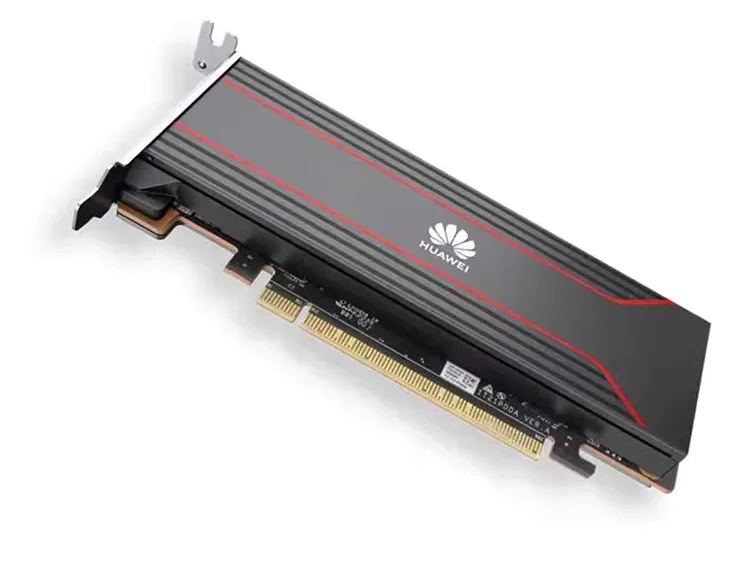
In the context of the competition, the card ranks among solutions like NVIDIA’s A100 or similar AI accelerators – although direct comparisons are limited. Huawei, for example, claims that their AI chips achieve performance close to the A100. This means that the Huawei Atlas 300I Duo AI GPU can already serve as an alternative in AI inference performance classes today.
| Parameter | Value |
| AI processors | 2 × Ascend AI processors (used in the Atlas 300I Duo module) |
| Performance (INT8) | up to ~280 TOPS (claimed) |
| Performance (FP16) | ~140 TFLOPS (reported) |
| Memory | LPDDR4X – Capacity: 48 GB or 96 GB |
| Memory bandwidth | approximately 408 GB/s (for the entire card) |
| Interface | PCIe Gen4.0 (×16 support, reports of ×8 compatibility) |
| Maximum power consumption | approximately 150 W |
| Dimensions | 10.50 × 4.38 × 0.73 inch |
| Usage | neural network inference, video/image analysis, AI mass computing |
INT8: Fast AI computations with lower precision.
FP16: More accurate computations for more demanding AI tasks.
Computational AI hardware for data centers, not gamers
The Huawei Atlas 300I Duo AI GPU is not used for graphics rendering or gaming. It is an AI accelerator designed for inference, i.e. running already trained models in real time. It uses the Ascend architecture, which Huawei is developing to provide its own ecosystem without relying on NVIDIA solutions.
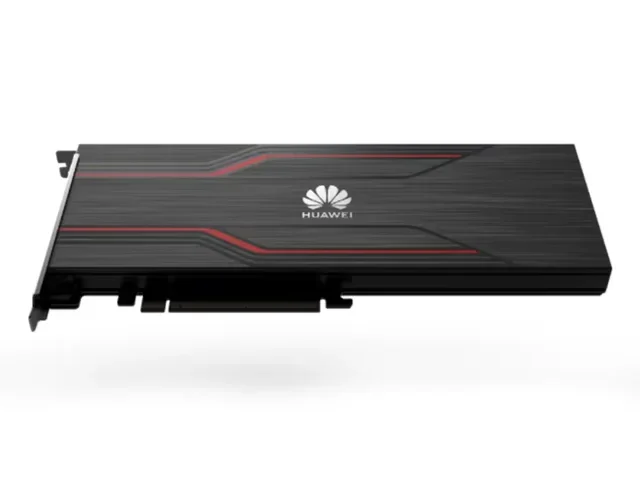
The dual-chip configuration, 96GB LPDDR4X, efficient PCIe Gen4.0 interface, and approximately 150W power consumption make this card a suitable solution for cloud deployments and parallel AI tasks. It does not need the maximum memory throughput of HBM as it is optimized for continuous operation and processing many smaller operations at the same time.
Performance-wise, it ranks in the AI inference segment, where the closest competitors are, for example, NVIDIA L4 or AMD Instinct MI210. For markets where Western accelerators are unavailable or prohibitively expensive, the Huawei Atlas 300I Duo AI GPU can provide a practical alternative for data centers.
Conclusion
The Huawei Atlas 300I Duo AI GPU is a practical solution for inferencing in data centers where memory capacity, stability, and power efficiency are important. The dual AI chip configuration, up to 96 GB LPDDR4X, PCIe Gen4.0, and power consumption of around 150 W give this card a place in the same class as NVIDIA L4 or AMD Instinct MI210 today.
This is not a product for gamers or the general public. The Huawei Atlas 300I Duo AI GPU is not sold freely and is mainly available for Huawei’s server partners. The estimated price of around $1,300 USD puts it among the more cost-effective options in segments where classic AI accelerators may not be available.